
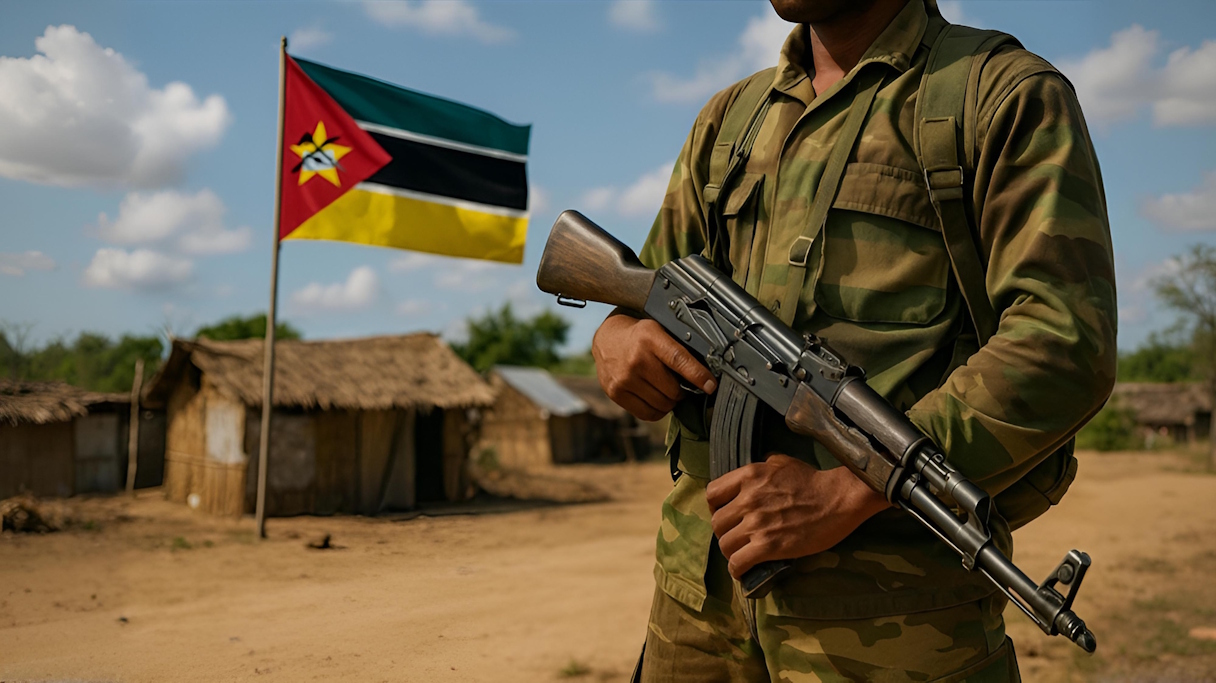

Eight years after the first major attacks in Cabo Delgado, Mozambique’s Islamist-inspired insurgency remains one of Southern Africa’s most persistent security crises. The movement no longer holds territory as it did in 2020 and 2021, but it continues to destabilise northern districts through dispersed violence, coercion, and deep entanglement with criminal networks.
Despite significant foreign military support and modest tactical successes, the conflict’s structural drivers remain fully intact. The result is a situation in 2025 that is neither improving nor collapsing: a contained threat, but very far from resolved.
Since 2017, the conflict has produced more than 2 300 recorded attacks, over 5 000 fatalities, and nearly one million displaced civilians. LNG investments worth over US$60 billion have been delayed or derailed. For Mozambique and the region, this is not a peripheral conflict — it is a long-term destabilising force with sharp geopolitical and economic implications.
Origins Still Matter: Grievance, Governance, and Opportunity
Early analysis often framed the violence as a foreign-driven jihadist project. But a combination of fieldwork, interrogation interviews, and community surveys over the last five years paints a more complex picture.
The roots of the insurgency lie in:
- long-standing socio-economic marginalisation
- rising resentment over resource extraction and LNG exclusion
- weak, predatory, or absent local governance
- an under-policed environment conducive to criminal networks
- identity-based grievances exploited by extremist clerics
From the beginning, the movement displayed hybrid characteristics — part ideological, part criminal, part insurgent.
By 2020, detailed analysis showed internal fragmentation, inconsistent leadership, and widespread forced recruitment. A 2022 ISS study underscored that the majority of recruits were coerced, manipulated, or economically trapped, rather than voluntarily radicalised. Religious identity served as a mobilising symbol, not a strategic compass.
In 2025, these dynamics remain unchanged. Ideology still plays a role, but the insurgency’s staying power derives from governance failure, economic exclusion, and state mistrust, not theological ambition.
Evolution of Tactics: From Territorial Control to Mobile Micro-Cells
The insurgency’s trajectory since 2017 can be divided into three clear phases:
Phase 1 (2017–2019): Low-tech brutality and symbolic violence
Fighters conducted machete raids, arson attacks, road ambushes, and village intimidation. Cells operated independently, relying heavily on coercion and opportunistic plunder.
Phase 2 (2019–2021): Consolidation and proto-state control
During this peak period, insurgents executed 300–400 attacks annually, seized Mocímboa da Praia, and controlled significant coastal and inland routes. Their media alignment with ISCAP grew, but operational independence remained evident.
Phase 3 (2022–2025): Fragmentation and regional dispersion
Rwanda’s deployment of over 3 000 troops and the SAMIM mission fragmented the insurgency’s territorial footprint. But this did not reduce the threat — it changed it:
- Attacks shifted to 15–25 per month, often smaller but geographically dispersed.
- New activity emerged in Niassa, Nampula, Ancuabe, Macomia, and border zones.
- Forced recruitment increased; voluntary ideological mobilisation declined.
- The movement integrated further into smuggling networks, including timber, gemstones, and heroin trafficking.
- Insurgent mobility replaced insurgent governance.
In 2025, the group resembles a decentralised ecosystem of armed micro-cells embedded within criminal markets. This makes it more durable — and harder to eliminate — despite reduced organisational coherence.
The State Response: Tactical Containment Without Strategic Progress
Mozambique’s state response has evolved, but not improved strategically.
1. Outsourcing of security
The country remains heavily reliant on external forces:
- Rwanda effectively secures Palma, Mocímboa da Praia, and LNG corridors.
- SAMIM’s withdrawal in mid-2024 removed an estimated 1 500–2 000 regional troops, leaving significant gaps in peripheral districts.
- Mozambique’s own forces remain under-trained, under-equipped, and hampered by poor mobility and limited airlift capability.
2. Weak justice and governance structures
Local communities consistently report:
- arbitrary detention
- corruption in policing
- abuse by security forces
- lack of legal recourse or functioning courts
This reinforces the insurgents’ narrative that the state is predatory or indifferent.
3. A reactive posture instead of a national strategy
Operations focus on clearing areas, not holding or rebuilding them. As soon as foreign forces redeploy, insurgents reappear. Humanitarian support remains inadequate, allowing displacement, hunger, and trauma to feed recruitment networks.
What Has Not Changed — and Why It Matters in 2025
The fundamental drivers of the insurgency persist:
- Youth unemployment remains acute.
- LNG governance continues to exclude local populations.
- Predatory local officials extract rents with impunity.
- Border management remains weak.
- Community mistrust of the state is largely unchanged.
These conditions sustain the insurgency even when its operational capacity is disrupted.
What Has Changed — and Why It Demands Regional Attention
While many of the insurgency’s early drivers remain unchanged, several important dynamics have shifted in ways that affect the broader region.
1. The conflict is increasingly regionalised
More than 150 cross-border incursions and smuggling incidents were recorded along the Tanzania–Mozambique corridor in 2024, indicating widening movement and recruitment patterns.
2. Criminal–extremist convergence has deepened
The insurgency is now entangled with illicit economies — from ruby and timber smuggling to heroin trafficking — creating diversified revenue streams that prolong the conflict.
3. Displacement pressures have reached nearly 1 million people
The sheer humanitarian scale destabilises communities, complicates governance, and fuels long-term recruitment vulnerability.
4. Maritime risk persists
Over 1 200 cargo and LNG vessels navigate the Mozambique Channel annually, leaving critical trade routes vulnerable to sporadic coastal attacks.
Implications for Southern Africa — and South Africa
Mozambique’s insurgency has direct and indirect consequences for South Africa:
1. Energy security risks
The delayed return of TotalEnergies and ExxonMobil projects undermines regional LNG diversification. South Africa stands to benefit from stable Mozambican production; prolonged instability delays that prospect.
2. Threats to maritime trade
Any increase in coastal raids or maritime disruption jeopardises shipping routes vital to Southern Africa’s economy.
3. Pressure on SANDF and SADC
South Africa’s overstretched SANDF faces increasing demands for regional stabilisation operations, while domestic capability gaps persist. The SAMIM withdrawal places more weight on bilateral deployments — a model South Africa is not structurally prepared to sustain.
4. Potential extremist spillover
Criminal-extremist networks seek porous borders and weak policing. South Africa’s own border vulnerabilities, policing challenges, and organised crime presence create opportunities for infiltration or logistical cooperation.
5. Strategic competition and external influence
Mozambique’s security vacuum increases space for non-African actors — state and non-state — to gain influence, shaping regional dynamics in ways that may not align with South Africa’s interests.
What South Africa Should Do
South Africa’s security interests are directly affected by the conflict, and several practical steps can strengthen both regional stability and domestic resilience.
1. Support intelligence fusion with Mozambique and Tanzania
A trilateral early-warning and intelligence-sharing unit would enhance tracking of cross-border movement and extremist networks.
2. Strengthen maritime domain awareness
Improved naval patrols, UAV surveillance, and air-based monitoring would help secure the Mozambique Channel.
3. Build Mozambican policing and governance capacity
Support for professionalising policing, improving investigations, and strengthening community engagement is essential for sustainable stabilisation.
4. Advocate for a long-term SADC stabilisation plan
South Africa should push for coordinated regional planning rather than ad hoc bilateral interventions.
5. Address domestic vulnerabilities
Internal weaknesses in border security, policing intelligence, and organised crime structures need urgent attention to prevent spillover.
Conclusion: Contained, Altered, but Not Ending
The Cabo Delgado insurgency is no longer the territorially ambitious force it was three years ago. But it has not faded. Instead, it has embedded itself into the social, economic, and criminal fabric of northern Mozambique.
With nearly one million displaced, thousands killed, and billions in economic losses, the crisis has evolved into a chronic regional threat. Tactical containment is not strategic resolution — and unless Mozambique addresses governance, inclusion, and justice, the conflict will simply mutate again. For Southern Africa, and especially for South Africa, Cabo Delgado represents a clear warning: weak governance and entrenched grievance can fuel long-term instability that crosses borders, disrupts economies, and demands sustained regional attention.
Read more background:
- Onheilspellende wending ná moorde in Mosambiek, 18 Junie 2019
- Mosambiek in tweeledige krisis, 21 November 2024