
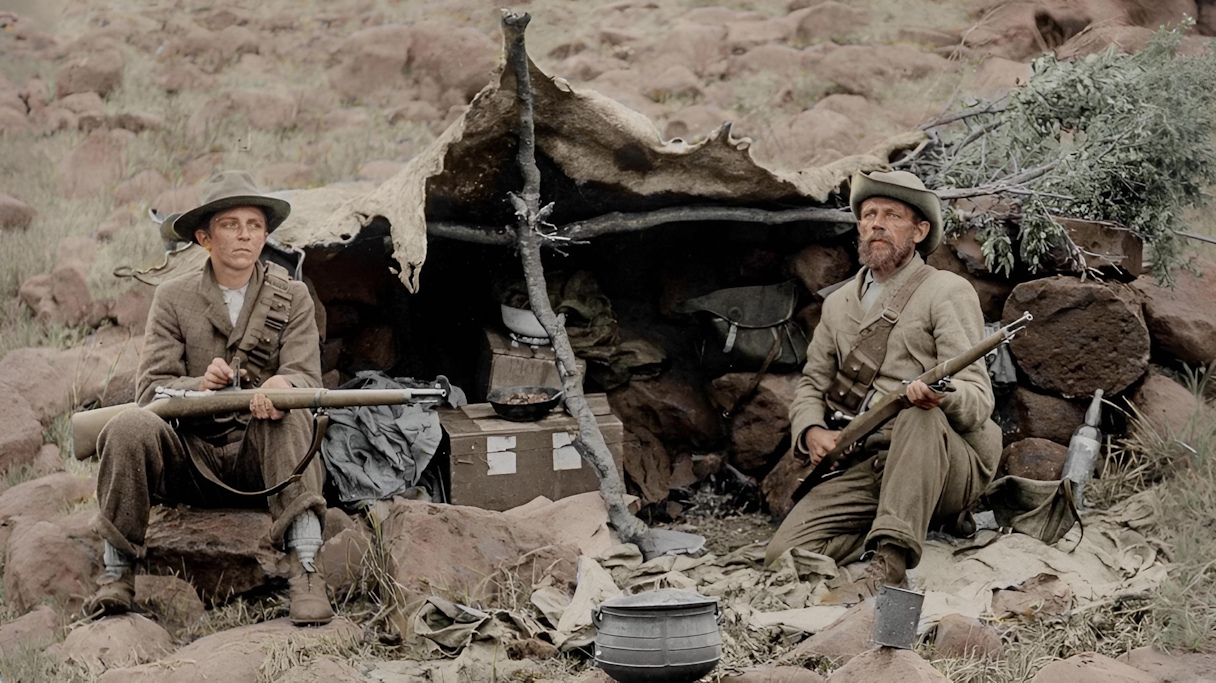

When the Second Anglo-Boer War broke out in October 1899, few in London expected a long conflict. The British Empire, then at its height, assumed that a militia of farmers could not stand against the world’s most powerful army. Yet the Boers did more than resist—they exposed the weaknesses of nineteenth-century military orthodoxy and anticipated many principles of modern manoeuvre warfare.
Through three years of mobile fighting, they practised what we would now recognise as mission command: small, self-reliant units operating with initiative within a clear commander’s intent, guided by local intelligence and extraordinary fieldcraft. For the British, the war became a painful school of adaptation. Its lessons reshaped counter-insurgency doctrine, informed twentieth-century operational art, and still echo in today’s security environment, where agility and legitimacy often matter more than size.
A New Kind of War
As Gregory Fremont-Barnes observed, the Boers introduced an entirely new style of fighting to the British Army—one that combined modern weapons, rural mobility, and deep local knowledge (1). With their Mauser rifles, smokeless powder, and mastery of terrain, Boer commandos entrenched unseen, fired from concealment, and vanished before artillery could respond.
Their strategy relied not on mass but on mobility, dispersion, and moral cohesion. Commandants such as Christiaan de Wet and Koos de la Rey struck where least expected, using local intelligence networks, night movement, and psychological surprise (2). It was a war of endurance and cunning, fought by men who viewed the land itself as their ally. In modern terms, they achieved economy of force—maximum effect with minimal resources.
British Adaptation and Overreach
As historian André Wessels notes, the British entered the war with divided commands and without a unified strategy (3). The devastating defeats of “Black Week” in December 1899—Stormberg, Magersfontein, and Colenso—forced London to rethink every assumption about command, logistics, and reconnaissance.
Lord Roberts and later Lord Kitchener responded with industrial-scale countermeasures: blockhouse lines, scorched earth, and concentration camps. These created the world’s first networked grid of fortified infrastructure—an early form of area control—but at enormous humanitarian cost. As Martin Bossenbroek explains, that moral price reshaped how the war would be remembered and legitimised in South African memory (4).
Operationally, however, the British learned hard but valuable lessons: decentralised intelligence collection, protected logistics, and coordination between mounted infantry and rail. The campaign foreshadowed later counter-insurgency theory, where victory depended as much on controlling populations as on winning battles.
By contrast, the Boers waged war on a fraction of the budget. Whereas the British drew on imperial wealth and global supply lines, the republics relied on local resources and improvisation. As H.P. Fairchild recorded in 1902, the British war effort cost more than £200 million—an astronomical figure for the time—while the Boers sustained their operations largely through community networks, local production, and knowledge of the terrain (8). Necessity forced efficiency. Ironically, the empire with limitless resources often found itself immobilised by them, while its adversaries moved lightly and survived through adaptability. In contemporary terms, the Boers were an early model of a “light force”: agile, sustainable, and economically coherent.
The Birth of Modern Mission Command
While German theorists later codified Auftragstaktik, its essence was visible in the Boer commando system. Units operated semi-independently within broad directives, exercising initiative rather than waiting for orders. Discipline stemmed from shared purpose and mutual trust, not rigid hierarchy.
Pretorius and Scholtz both emphasise that this cohesion rested on social bonds and the legitimacy of leadership (5, 6). Decisions were often discussed in the laager, but once taken, execution was swift. The ability to combine freedom of action with unity of effort offers a timeless lesson: in dispersed operations, intent must be so well understood that control becomes implicit.
For today’s South African National Defence Force (SANDF), the principle remains relevant. A small, professional force must leverage initiative, decentralised command, and local intelligence to remain effective in a vast and complex environment. Commanders should communicate intent, not micromanage execution.
Technology, Terrain, and Adaptation
Each generation translates these principles through its own tools. In 1899, horses and Mausers were the disruptive technologies; today they are drones, sensors, and precision munitions. The challenge endures: how to combine speed, stealth, and information to outmanoeuvre stronger opponents.
As Spencer Jones recently argued, the British Army’s post-Boer War reforms—and its later struggles after Afghanistan—both revealed the same institutional dilemma: how to transform battlefield experience into lasting learning (7). For South Africa, the message is similar. Technology should amplify human judgement, not replace it. The modern equivalent of the commando lies in low-signature teams that integrate digital intelligence, autonomous reconnaissance, and strong human networks.
The Moral Dimension
The Boer War also demonstrated the limits of purely military victory. The British “methods of barbarism”—farm burnings and civilian camps—secured control but deepened resentment (2). Coercion without consent breeds resistance.
That moral lesson endures in peacekeeping, internal security, and border operations today. Legitimacy is a strategic asset. The ethical use of force—proportionate, disciplined, and population-conscious—remains central to success. The war thus linked morality and economy: power that exhausts or alienates its own people ultimately undermines itself.
Enduring Relevance for South African Defence
South Africa’s geography and threat landscape—vast, open, and increasingly asymmetric—echo the conditions of 1899. Yet today the threats come from non-state actors, insurgents, and criminal networks rather than imperial armies. The challenge is not to occupy territory but to secure communities and infrastructure across great distances.
For the SANDF, the key lessons are clear:
- Decentralise mission command at platoon and company level.
- Integrate local intelligence and community relations.
- Treat mobility as protection, not merely transport.
- Safeguard national lifelines—energy, logistics, communications—as the new “rail war.”
- Maintain moral legitimacy as the foundation of authority.
The Boer commandos mastered warfare without over-centralisation. They proved that agility, intelligence, and trust can overcome numerical inferiority. Their legacy is not nostalgia but a blueprint: a lean, adaptive, and ethically grounded defence posture for the modern age.
Final Thoughts
From the kopjes of Magersfontein to today’s semi-permissive border zones, the enduring truths of dispersed warfare remain the same: know your terrain, trust your people, move fast, and protect civilians. The Boers learned these lessons through necessity; the British through defeat. South Africa can learn them through reflection—and build a defence force as resourceful as the land it serves.
Endnotes
- Gregory Fremont-Barnes, The Boer War 1899–1902 (Oxford: Osprey, 2014), 10–15.
- Denis Judd and Keith Surridge, The Boer War: A History (London: John Murray, 2013), 178–192.
- André Wessels, “An Assessment of British Military Strategy During the Anglo-Boer War up to ‘Black Week’,” Journal for Contemporary History 27 (2002): 4–6.
- Martin Bossenbroek, The Boer War (New York: Seven Stories Press, 2017), 20–25.
- F. Pretorius, The Anglo-Boer War (Johannesburg: Human & Rousseau, 1985), 112.
- J. H. Scholtz and J. C. Theron, The Anglo-Boer War 1899–1902 (Pretoria: Protea, 2000), 45–47.
- Spencer Jones, “The British Army and the Lessons of the Boer War,” War on the Rocks, 11 March 2024.
- H. P. Fairchild, The Financing of the South African War (New York: Macmillan, 1902), 87–92.
** Originally published by DefenceWeb