
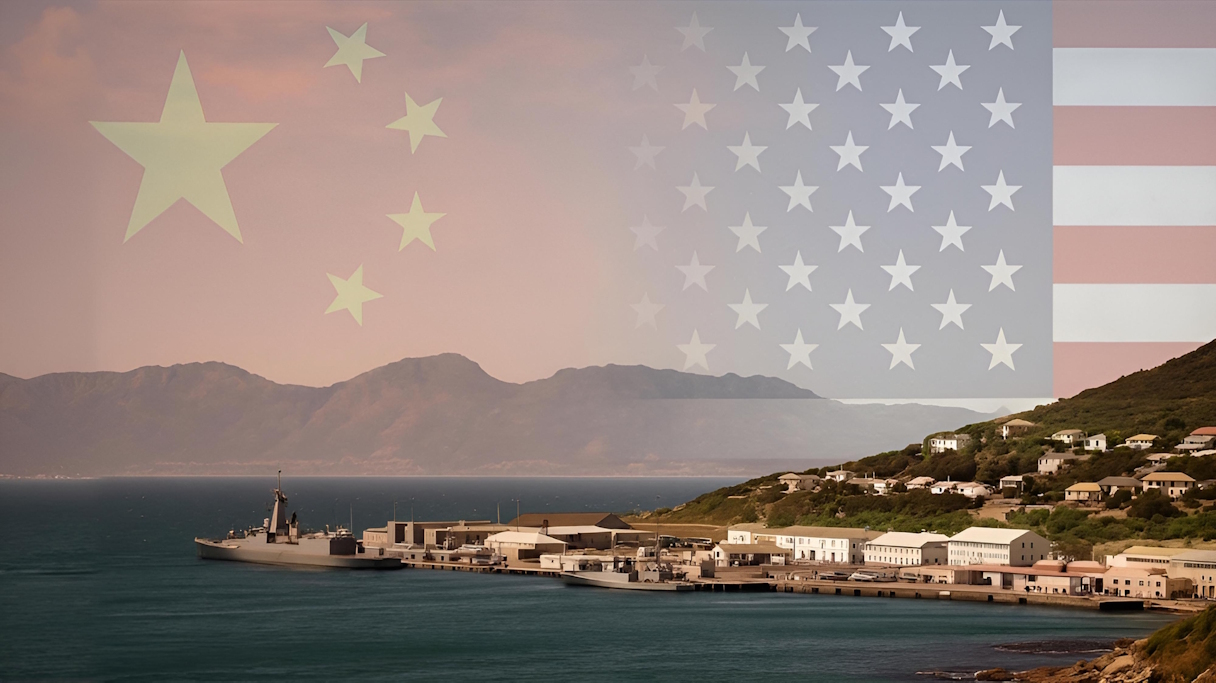

The global security environment is shifting faster than many policymakers care to admit. As great-power rivalry deepens, global trade reroutes through the Cape sea lane, and instability continues in the Red Sea corridor, one strategic asset has quietly emerged at the centre of a new geopolitical contest: Naval Base Simon’s Town, at the tip of South Africa.
The base is not only the headquarters of the South African Navy — it is also one of the most strategically located naval facilities on earth, positioned at the maritime hinge between the Indian and South Atlantic Oceans. Although Washington maintains discreet awareness and engagement around South Africa’s strategic maritime assets, Simon’s Town has not yet become a front-facing priority. This creates a window in which China’s incremental advances — from naval visits to infrastructure involvement — are reshaping the balance quietly and without public contestation.
This is a warning that deserves attention before events outpace strategy.
A New Maritime Chessboard
For over a century, the Cape route has been a strategic fallback whenever the Suez Canal is threatened or constrained. In the past five years, disruptions in the Red Sea, Houthi missile and drone attacks, Somali piracy resurgence, and broader geopolitical recalculations have expanded the Cape corridor’s relevance. Shipping giants such as Maersk and MSC increasingly shift vessels around Africa, effectively reviving a route long thought secondary.
Whoever holds influence over the Cape route — and the naval infrastructure that protects it — will exert disproportionate leverage over global sea lines of communication. Simon’s Town is the critical node in that system.
In a world returning to naval competition and maritime coercion, that makes it a prize.
A Weak South African State Creates Openings
South Africa today is a country adrift. The South African National Defence Force (SANDF) is underfunded, hollowed out, and suffering from chronic maintenance failures. Years of budget cuts, corruption, and political neglect have left its naval capabilities threadbare. The country struggles to maintain even basic patrol capacity along its vast coastline.
This weakness is not a secret. It is a strategic opportunity — the kind great powers exploit.
A cash-strapped government desperate for foreign investment, diplomatic cover, and emergency infrastructure support is far more likely to agree to deals that quietly trade access for assistance. China understands this. It has executed versions of this across Africa, from Djibouti to Equatorial Guinea. There is no reason to believe it views South Africa differently.
China’s Expanding Footprint: The Quiet Path to Influence
There is no public evidence of a formal Chinese naval base at Simon’s Town. But this is not how modern basing works.
China’s approach — refined from Sri Lanka to the Solomon Islands — follows a consistent pattern:
- Begin with “harmless” port calls and humanitarian visits.
- Expand into maintenance support, training, or “capacity-building.”
- Insert Chinese contractors into strategic infrastructure.
- Use long-term maintenance or upgrade projects as leverage.
- Convert dependence into influence — and influence into access.
South Africa has already crossed several of these thresholds.
Chinese warships have made repeated visits to Simon’s Town, including increasingly frequent joint exercises. Chinese technicians and contractors have become involved in defence infrastructure upgrades, some of which have been flagged by local analysts as opaque or irregular. At least one project was reportedly shielded from oversight under the classification laws.
This is not a conspiracy — it is the visible outline of a familiar playbook.
Chinese port visits, maintenance interactions, and military cooperation are not concerning on their own. What is concerning is the trajectory, especially when paired with a weakened defence force and a ruling party seeking geopolitical protection from Beijing.
In geopolitics, power often shifts incrementally — slowly at first, then all at once.
Why Simon’s Town Matters to the United States
The United States cannot treat Africa, and especially southern Africa, as a peripheral theatre any longer. The old assumption — that Africa is too unstable, too economically marginal, or too distant to matter — is strategically obsolete.
South Africa, despite its political chaos, holds:
- the most advanced naval base in sub-Saharan Africa;
- a commanding position over the Cape sea lane;
- essential refuelling and repair facilities;
- the logistical and maritime infrastructure that global navies depend on in contingencies.
If China were ever to gain privileged access, docking rights, maintenance rights, or even influence over decisions at Simon’s Town, it would fundamentally alter maritime dynamics from the Indo-Pacific to the Atlantic.
This does not require a Chinese flag to be raised over the base.
Influence can be enough.
Dependency can be enough.
A long-term “technical support agreement” can be enough.
Great-power competition rarely announces itself with fanfare. It emerges through contracts, infrastructure projects, tenders, and joint exercises — until one day the balance has shifted.
A Strategic Reality Check for Washington
The United States does not need to “re-engage” with Pretoria — it needs to reassess its leverage. A future US administration, particularly one aligned with Trump’s foreign-policy instincts, will not rely on charm offensives or moral suasion. It will act where its interests are threatened and apply pressure where it is most effective.
In practice, this means:
- Treating Chinese encroachment at Simon’s Town as a direct challenge to US maritime interests, and responding with clear conditionality on trade, intelligence sharing, and access to US markets.
- Using America’s unmatched financial, technological, and security leverage to signal that cooperation with Beijing on sensitive defence infrastructure carries a cost.
- Deepening security and economic ties with the Western Cape, where governance is functional and the population is more aligned with Western norms. Pretoria may resist, but Washington has long worked through regional partners when national capitals become unreliable.
This is not about diplomacy or winning hearts. It is about safeguarding strategic corridors and limiting Beijing’s ability to project power into the Atlantic. A transactional, interest-first approach aligns far more closely with how Washington now views global competition — and Simon’s Town fits squarely within that framework.
The Time to Act Is Now
Simon’s Town is not yet a Chinese foothold — but the ingredients are all present, and the incentives are aligned. The United States must not wait for a crisis to take this risk seriously.
The Cape is becoming strategically indispensable again. Whether Washington sees it in time will determine who shapes the next chapter of the global maritime order.
Now is the moment for vigilance — before someone else claims the advantage.