
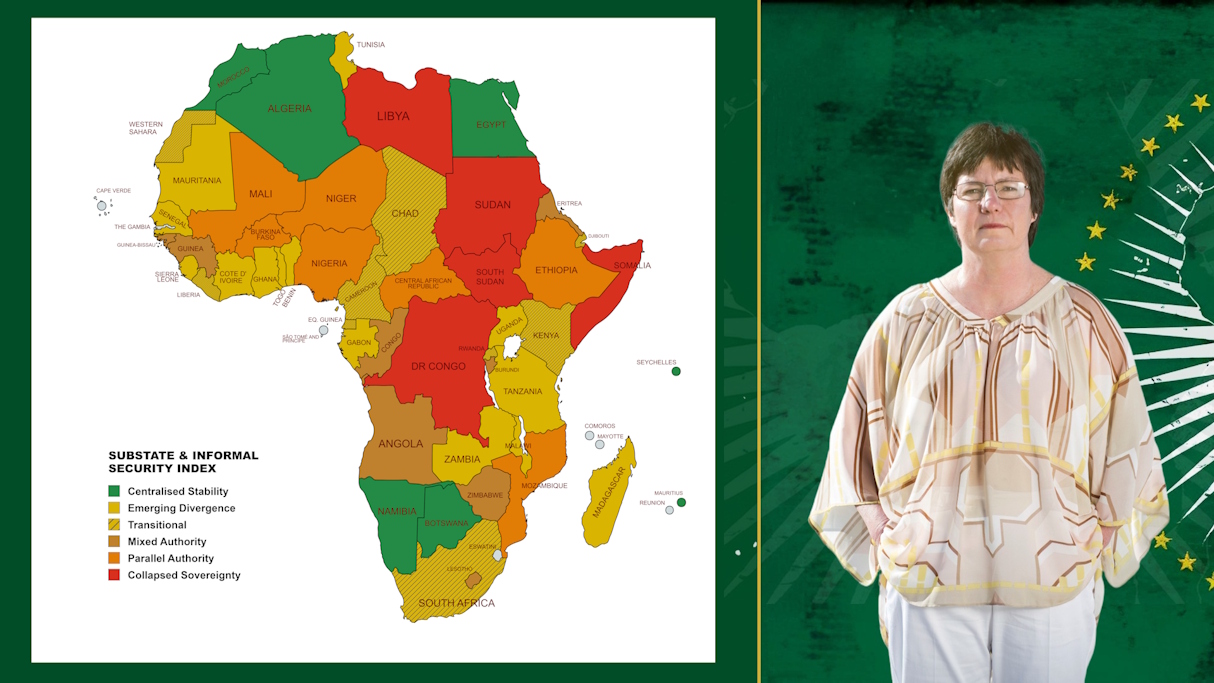

Introduction: The Hidden Continental Shift
Across Africa, a quiet but consequential reconfiguration of power is underway. It does not follow the familiar narrative of coups, rebellions or peace deals. It is deeper and more structural: a continental evolution in which the authority of the central state is weakening while alternative centres of governance — provincial administrations, armed movements, political-criminal syndicates, traditional authorities, and proto-states — rise to fill the gaps.
In earlier analysis, my Foreign Policy Orientation Map illustrated how African states align with global powers. But alignment is only half the picture. Foreign policy reflects power; it does not create it. The real question is: who actually has authority on the ground?
This is what the new Substate & Informal Security Index (SISFI) attempts to map. By measuring the erosion of state authority, the emergence of competing power centres, and the consolidation of alternative governance structures, SISFI reveals a continent where the traditional nation-state is no longer the only, or even the primary, provider of security.
Africa’s political geography is being redrawn — not at national borders, but within them.
The Three Pillars of Africa’s Emerging Security Order
At the heart of the SISFI model are three analytical pillars, each capturing a different dimension of security fragmentation.
These pillars help explain why some states fracture violently (Pillar B), why others evolve into coherent proto-states (Pillar C), and why still others hold onto centralised stability (Pillar A). They also show that not all fragmentation is equal — and not all decentralisation is dangerous.
Below is the conceptual model referred to in this section:

Pillar A: State Strength and Centralised Control
Pillar A measures the capacity of the formal state to govern — its monopoly on force, administrative performance, institutional coherence, rule of law, and ability to provide essential services. Strong Pillar A states, such as Morocco, Egypt, Namibia and Botswana, maintain predictable governance even in a turbulent region.
Where this pillar weakens, two possible trajectories emerge.
- Fragmentation through violent or unregulated competition
- Orderly divergence through the rise of functional subnational entities
This is the central insight: state weakening does not always lead to disorder. The next two pillars describe which direction a country is more likely to take.
Pillar B: Substate Competition and the Rise of Informal Power
Pillar B captures environments where weakening state control is met not by institutional alternatives, but by competing armed or informal groups.
In these environments, the vacuum left by a weakening state is quickly occupied by a wide range of competing actors. Warlords assert territorial control, ethnic militias police local communities, political-criminal networks exploit the absence of formal authority, extremist movements take root where governance is hollow, and a constellation of fragmented local power brokers negotiate influence on a district-by-district basis. Together, they create a layered and often volatile security landscape in which no single actor holds uncontested authority.
This produces layered sovereignty — multiple actors extracting, taxing or providing “security” in overlapping jurisdictions.
This pattern is particularly evident in countries where Pillar B dynamics dominate.
Nigeria’s northwest and northeast regions operate under parallel armed structures; Cameroon’s Anglophone areas reflect similar pressures; and the Democratic Republic of Congo remains the world’s most complex mosaic of armed governance. South Sudan continues to fracture along factional and ethnic lines, while Mali, Burkina Faso and Niger have shifted from state authority to insurgent-dominated zones. Libya’s factionalised armed coalitions and Sudan’s brutal dual-sovereignty between the SAF and RSF further illustrate how deeply entrenched competitive security ecosystems have become. Somalia, long a case study in fragmented sovereignty, completes this group.
These are states where the monopoly on force has collapsed or been severely diluted. Fragmentation tends to be violent, decentralised and unpredictable. Security becomes transactional rather than institutional.
This is fracturing without consolidation.
Pillar C: Subnational Governance and Proto-State Formation
By contrast, actors associated with Pillar C trajectories often display characteristics that resemble functional statehood.
Many of these subnational authorities possess genuine political legitimacy, exercise administrative competence, enforce laws through structured institutions, maintain tax bases, and operate predictable security arrangements. Their institutions — whether formal or hybrid — provide stability and coherence in ways that rival or exceed the performance of the national government they ostensibly fall under.
Examples include:
- Somaliland — diplomatically unrecognised yet highly functional.
- Puntland — stable within a failing national framework.
- Zanzibar — a semi-autonomous archipelago with strong local governance.
- Western Cape — a high-performance outlier inside a national system in distress.
- Northern Ghana and Senegal’s Dakar region — subnational anchors of stability.
- Tigray and Amhara (periodically) — demonstrating how regional strength can rival national power.
Unlike Pillar B, this is divergence with consolidation.
Subnational actors here increasingly interact with global players not as “local administrations,” but as functional units of governance. They attract investment, partnerships and diplomatic engagement precisely because they offer predictability, the most important currency in international security and economics.
Understanding the Map: A Continental Pattern Emerges
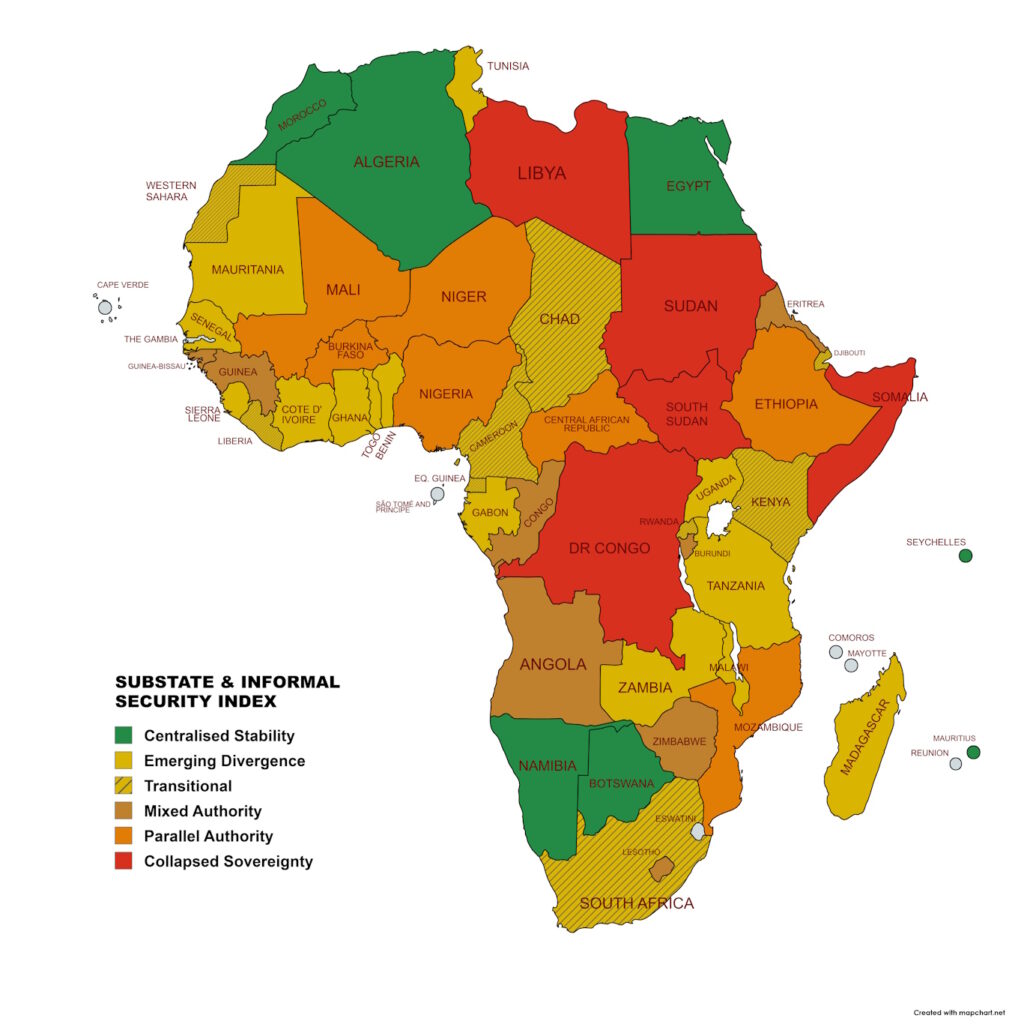
Substate & Informal Security Index — Africa 2025
The SISFI map illustrates how these three pillars produce six distinct country categories. More importantly, it reveals a clear continental pattern: centralised stability is now the minority condition. Africa’s security order is shifting toward hybrid governance arrangements where formal and informal authorities coexist.
Several observations stand out:
1. The Sahel is collapsing into Pillar B dominance
The arc from Mali through Niger and Burkina Faso into Sudan and Somalia represents the largest zone of violent, competitive sovereignty on Earth. States are increasingly nominal entities, while armed networks determine control.
2. East Africa is a mosaic of Pillar B and Pillar C dynamics
Kenya and Tanzania face pressures but maintain coherence. Ethiopia oscillates between centralised assertion and regional fragmentation. Somalia combines both extremes — coherent proto-states (Somaliland/Puntland) alongside complete national disintegration.
3. Southern Africa shows emerging divergence
South Africa, Angola, Zambia, Mozambique and Zimbabwe are drifting away from centralised stability. While not yet fragmented, they are entering a volatile transitional space where parallel authority and criminal governance are rising.
4. North Africa splits sharply
Morocco, Algeria and Egypt remain coherent. Libya and Sudan are collapsed. Tunisia is delicately balanced between the two.
Why This Matters: Security, Economics, and Great-Power Competition
The implications of this shift are substantial across several domains:
Security
National armies no longer guarantee territorial order. In many countries, stability depends more on provincial leadership, local militias, or external partners than on national security institutions.
Economics
Investment gravitates toward functional substate actors. When a province, island region or autonomous administration offers reliability, investors privilege it over the national capital — a trend already visible in East Africa, Somaliland, Ghana’s regions and South Africa’s provinces.
Diplomacy
Global powers increasingly bypass national governments to work with whoever can deliver access, stability or resources. China, the US, Turkey and the Gulf states already engage substate entities informally.
Self-Determination and Legitimacy
Where central governance fails, local populations gravitate toward governance structures that meet their needs. Pillar C entities are increasingly seen as vehicles for legitimate self-determination, not secessionist threat.
This is why Somaliland, Western Sahara, Puntland, Zanzibar and the Western Cape are strategically important. They represent alternative models of political order that challenge the assumption that the African nation-state is the only legitimate actor.
The Future: Africa’s Post-State Security Architecture
Africa is not heading toward uniform collapse or uniform decentralisation. Instead, it is moving into a hybrid future where sovereignty is layered, negotiated and diversified.
The essential question for policymakers, investors, international partners and African citizens is no longer:
“Is the state stable?”
but rather
“Who actually governs — and how effectively?”
The SISFI framework offers one way to answer that question. It identifies where the state still holds authority, where it is losing it, and where new, possibly more functional authorities are emerging.
Africa’s security future will be shaped not just by its presidents and parliaments, but by the subnational actors who increasingly provide the real governance on the ground.
Understanding them is essential. Ignoring them is no longer an option.
* Oorspronklik gepubliseer deur Maroela Media