
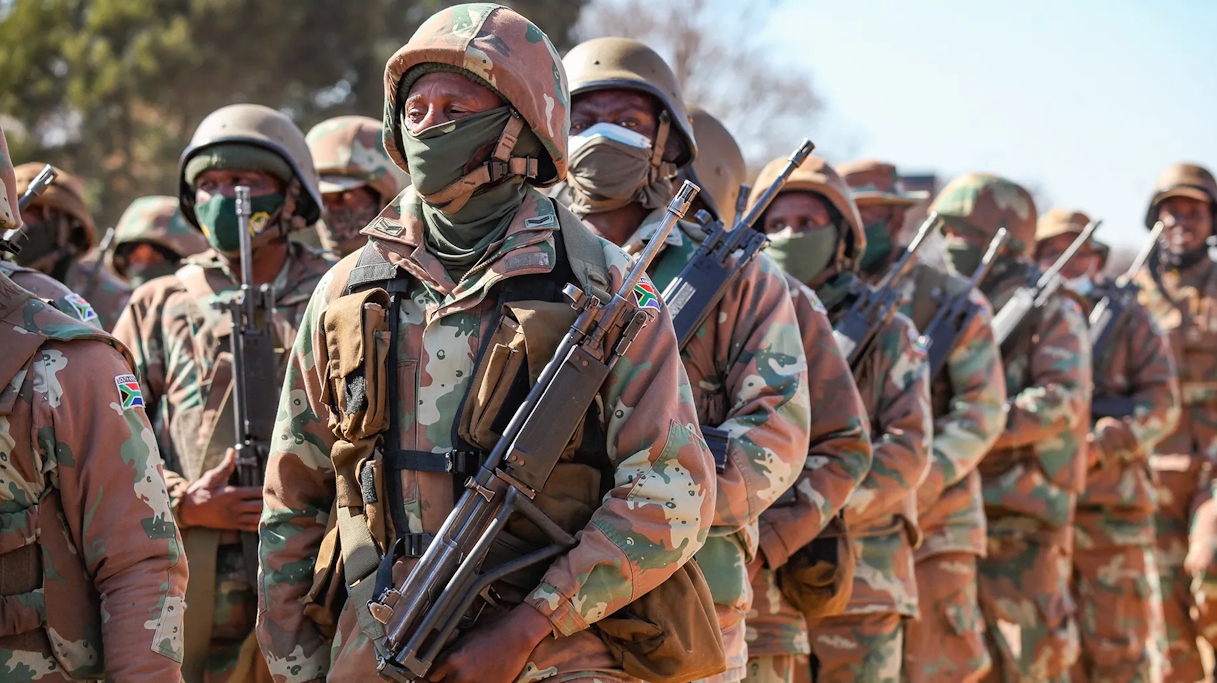

In the dense jungles of the Democratic Republic of Congo (DRC), South African National Defence Force (SANDF) troops have faced relentless attacks from rebel groups like the M23, with January’s death of 14 soldiers exposing vulnerabilities in equipment and readiness. Closer to home, Operation Corona deploys soldiers along porous borders to combat illegal crossings and smuggling, yet persistent gaps allow threats to seep through.
These snapshots highlight the SANDF’s dual role: safeguarding South Africa’s sovereignty while contributing to regional stability through missions under the African Union (AU), United Nations (UN), and Southern African Development Community (SADC).
Born from the ashes of apartheid, the SANDF has aimed to transform from a tool of oppression into a democratic institution, integrating former adversaries and prioritising human security.
However, chronic budget constraints – defence spending hovers at a mere 0.7% of GDP against the international norm of 2% – have eroded its capabilities, leading to decaying infrastructure, ageing fleets, and operational overstretch.
This article examines the SANDF’s core responsibilities, its strategic evolution since 1910, current shortcomings, and feasible pathways to improvement within fiscal limits. By embracing efficiency and innovation, the SANDF can reclaim its effectiveness without awaiting improbable funding windfalls.
Core responsibilities of the SANDF
The SANDF’s mandates are enshrined in Section 200 of the South African Constitution, tasking it with defending the Republic, its territorial integrity, and its people in line with international law. Primary duties focus on external threats, including conventional warfare preparedness and maritime security to protect exclusive economic zones from piracy and illegal fishing. Secondary roles encompass internal support, such as aiding the South African Police Service (SAPS) in combating crime, disaster relief operations (e.g., flood responses), and border patrols under initiatives like Operation Corona to curb transnational threats. Regionally, the SANDF contributes to peacekeeping, as seen in MONUSCO (United Nations Stabilisation Mission in the DRC) and SAMIM (Southern African Development Community Mission in Mozambique), fostering stability across Africa.
The 2015 Defence Review further emphasises these as part of a broader security architecture, positioning the SANDF as a key player in the African Union’s Agenda 2063 for silencing the guns. In response to evolving warfare trends, including the rise of hybrid threats that blend military and non-military tactics, the SANDF is tasked with addressing cyber incursions, such as attacks on critical infrastructure like Transnet and Eskom, and resource-induced conflicts exacerbated by events like regional droughts, floods, and tribal strife.
Post-1994 integration of forces like Umkhonto we Sizwe (MK) and the Azanian People’s Liberation Army (APLA) has diversified the SANDF, enhancing its legitimacy but also introducing challenges in cohesion and resource allocation. This underscores the force’s pivotal role in hybrid threats, from cyber incursions to climate-induced conflicts.
Evolution of SANDF strategies
The SANDF’s strategies have undergone profound transformations, reflecting South Africa’s shifting political landscape.
1910-1961: Defensive and imperial alignment
Established as the Union Defence Force (UDF) in 1912 following the Union of South Africa, early strategies emphasised territorial defence and support for British imperial interests. Participation in World War I (e.g., German South-West Africa campaign) and World War II (e.g., North African battles) honed expeditionary capabilities, but racial segregation limited recruitment to white troops initially, with non-whites in auxiliary roles. Influenced by colonial ties, the focus was on mobility and alliances, though isolation grew after the 1961 Republic declaration amid anti-colonial sentiments.
1961-1994: Apartheid’s Total Strategy
Renamed the South African Defence Force (SADF), strategies shifted to aggressive “forward defence” under PW Botha’s regime, countering what the regime framed as a “total onslaught” from communist-backed liberation movements. This framing justified a comprehensive response to real threats, including armed incursions and terrorism within South Africa, as well as regional conflicts such as the South African Border War in Angola – where Cuban and Soviet support bolstered opposing forces – and destabilising interventions in neighbouring countries like Mozambique and Zimbabwe (then Rhodesia), leading to widespread humanitarian and economic devastation. While the threats were tangible, manifesting in bombings and guerrilla warfare by groups like the ANC’s MK, the regime’s “total strategy” encompassed not only military actions but also political and economic measures, often criticised for exacerbating regional instability and internal repression to preserve apartheid. Conscription expanded the force, and nuclear capabilities added deterrence, but international sanctions strained resources, leading to de-escalation by the late 1980s as negotiations loomed.
Post-1994: Democratic transformation and peacekeeping
The SANDF emerged through integration of seven forces, downsizing from over 90 000 to around 74 000 personnel, and adopting a human-security paradigm aligned with the Constitution. Strategies pivoted to non-aggressive roles, emphasising peacekeeping (e.g., Burundi, DRC) and regional cooperation via the SADC. Initiatives like “African Warrior” aimed at modernisation, with gender integration and welfare focus, but budget cuts have hampered implementation. This evolution has positioned the SANDF as a stabiliser, though much of the equipment from past eras has been destroyed or rendered inoperable through neglect, corruption, and underfunding, with outdated doctrines potentially still unaddressed.
Shortcomings, limitations, and failures
Despite its mandates, the SANDF grapples with systemic failures exacerbated by budget constraints.
The defence allocation, at 0.7% of GDP, creates a R41.2 billion shortfall, with 64-68% consumed by salaries, leaving scant resources for maintenance or procurement. Equipment decay is rampant: few operational fighter jets, ageing naval vessels, and delayed deliveries of armoured vehicles like Badger infantry fighting vehicles. Deployments suffer from overstretch, as evidenced by heavy casualties in the DRC and underperformance in SAMIM, where inadequate gear hampers effectiveness. Human resource issues compound this – an average age of 39 signals stagnation, with the force resembling a welfare system rather than a combat-ready entity. Procurement inefficiencies through Armscor and Denel, marred by delays and corruption, further erode capabilities.
The 2019-2022 mid-term review noted mixed progress, with successes in domestic tasks but failures in force readiness, threatening regional stability amid rising threats like hybrid warfare.
Pathways to improvement within constraints
Addressing these issues requires “smart austerity” – reforms that maximise efficiency within the R57 billion 2025/26 budget.
Reprioritisation is key: concentrate on core mandates like border security via Operation Corona, scaling back expansive external commitments to align with fiscal realities, and adopting interim force designs for cost-effective midlife upgrades of assets such as Gripen jets or Rooivalk helicopters, potentially trimming capital costs by 20-30%. Emphasise the “Soldier First” approach by reallocating funds to essentials like uniforms, protective gear, and inclusive facilities, boosting morale without net increases.
Human resource rejuvenation offers substantial savings: implement phased exit mechanisms for the 74 000-strong force to reduce the 64% compensation burden, targeting a younger average age through recruitment and integrating the Reserve Force as a low-cost surge option. Pilot “Model Units” to test upgrades in training and welfare, serving as scalable blueprints for readiness enhancements.
Streamline procurement by enforcing anti-corruption measures and digitisation in Armscor and Denel, with quarterly audits and risk-based oversight to curb overruns and eliminate repeat audit findings. Prioritise local sourcing for supplies to cut import dependencies.
Forge partnerships: public-private collaborations with the South African Defence Industry (SADI) for maintenance, exports, and job creation; international tech transfers from allies like the US for affordable drones, cyber tools, and electronic warfare suited to hybrid threats. Develop a Defence Industry Sector Policy to attract investment and generate revenue.
Integrate these via a new Defence Review for strategic alignment, alongside the “Journey to Greatness” initiative for logistical sustainability and intelligence-driven operations. This holistic approach can restore viability affordably.
Conclusion
The SANDF’s historical evolution underscores its adaptability, yet budget constraints demand immediate, disciplined reforms to recorrect its defensive and stabilising roles. By prioritising efficiency in human resources, procurement, and partnerships, the force can mitigate shortcomings like equipment decay and overstretch, ensuring operational viability amid fiscal realities. This approach positions the SANDF as a resilient pillar of South African and regional security.
- Published by DefenceWeb